

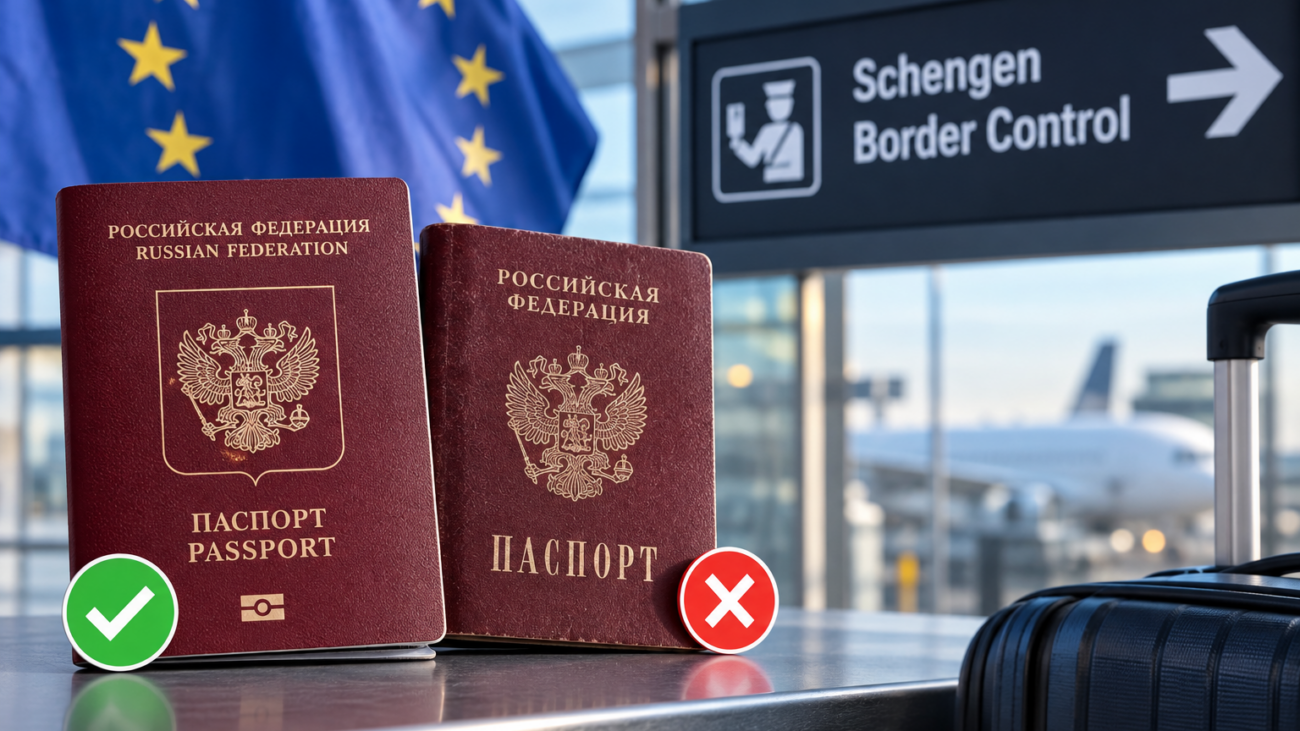
The international mobility of Russian citizens travelling to Europe continues to undergo numerous changes. In recent years, several European countries have taken measures to restrict the recognition of certain travel documents issued by the Russian Federation, particularly old-format non-biometric Russian passports.
These measures directly affect Russian citizens travelling to Europe for work, family, business or tourism purposes. They make it necessary to carefully review travel documentation before arranging any international trip.
The growing non-recognition of non-biometric Russian passports by several European countries is a new factor that must be taken into account when planning immigration and international mobility. Although the applicable conditions may vary depending on the country of destination, the purpose of travel and the traveller’s circumstances, the general trend indicates increasingly strict requirements regarding the travel documents accepted by European authorities.
For this reason, it is highly advisable to check the requirements of each country before travelling, particularly when the journey involves entry into or transit through several European countries.
New restrictions for holders of non-biometric Russian passports
Non-biometric Russian passports are travel documents that do not contain an electronic chip storing the holder’s biometric data.
Several European countries have announced or implemented restrictions on the recognition of these documents, which may prevent their use for entry into certain territories or cause difficulties at border controls.
The countries that currently do not recognise the validity of these documents are:
- Czech Republic
- Estonia
- France
- Lithuania
- Latvia
- Denmark
- Iceland
- Germany
- Romania
- Poland
Exceptions to the rule
In Germany, if a German passport or a valid Schengen visa was obtained before 1 January 2026, it may continue to be used until its expiry date. The same rule applies to residence permits issued before this date.
In the Czech Republic, these passports remain valid for children under the age of 15, as well as for participants in the Civil Society Programme and holders of visas or residence permits issued in the interests of the Czech Republic.
In France, they may also continue to be used by children under the age of 15 until the expiry of their French visa or residence permit, provided that it was issued before 1 June 2025.
Finland, Sweden, Belgium, the Netherlands and Luxembourg will cease to recognise non-biometric Russian passports
From 1 October 2026, these five countries will join the above list. With the exception of Sweden and Finland, none of these countries provides for a transitional period.
Sweden will continue to accept these passports until 31 December 2026 if the holder has a valid visa issued before 1 October 2026 by Sweden, another EU country or a Schengen country, or if the holder has a residence permit issued by one of these countries before 1 October.
Finland will also accept them until the same date as Sweden, and the following exceptions will continue to apply:
- If the person applying for a residence permit is a minor throughout the entire procedure, from the beginning of the application process until its completion.
- If the Finnish Immigration Service has granted the person an extension or a permanent residence permit.
- If the Ministry for Foreign Affairs accepts or has accepted the document for special reasons following an individual assessment.
What is the situation in Spain regarding non-biometric Russian passports?
Unlike other European countries that have introduced specific restrictions, Spain has not established a requirement for Russian citizens to hold a biometric passport in order for it to be recognised as a valid travel document.
As a general rule, third-country nationals wishing to enter Spain must hold a valid and unexpired passport or travel document that establishes their identity and is recognised for the purpose of crossing external borders.
Furthermore, for entry into the Schengen Area, the travel document must comply with the validity requirements established under European legislation, including, subject to the exceptions provided for by law:
- having been issued within the 10 years prior to the date of entry; and
- remaining valid for at least three months after the intended date of departure from the territory of the Member States.
In this context, Spain generally recognises the ordinary passport of the Russian Federation as a valid travel document. With regard to ordinary Russian passports, Spain does not impose a general restriction based on whether the passport is biometric or non-biometric.
Therefore, the mere fact that an ordinary Russian passport is non-biometric does not, in itself, mean that Spain will cease to recognise it as a valid travel document.
Exception: documents affected by Commission Implementing Decision (EU) 2023/1061
The above should be distinguished from a specific restriction established at European Union level.
Commission Implementing Decision (EU) 2023/1061 of 31 May 2023 establishes certain travel documents issued by the Russian Federation that must not be accepted as valid travel documents for the purposes of issuing a visa or crossing external borders.
This restriction applies to all countries bound by the Schengen rules, including Spain, as well as Iceland, Norway, Switzerland and Liechtenstein through their association with the Schengen Area. Within the European Union, Ireland is not bound by this Decision and is not subject to its application.
Among other documents, the Decision applies to ordinary Russian passports issued in certain territories, or to persons residing in those territories, after the following dates:
- Crimea and Sevastopol: after 18 March 2014;
- Donetsk: after 24 April 2019;
- Luhansk: after 24 April 2019;
- Kherson: after 25 May 2022;
- Zaporizhzhia: after 25 May 2022;
- Kharkiv: after 1 August 2022;
- Abkhazia: after 26 August 2008;
- South Ossetia: after 26 August 2008.
Therefore, the restriction established by Decision 2023/1061 does not depend on whether the passport is biometric or non-biometric. The determining factors are where the document was issued, when it was issued and, in certain cases, where the holder resided.
Consequently, even a biometric Russian passport may not be recognised if it falls within any of the circumstances established by the Decision.
Add a Comment